
 directly, but I am a very old fashioned man and still use chemical
photography.
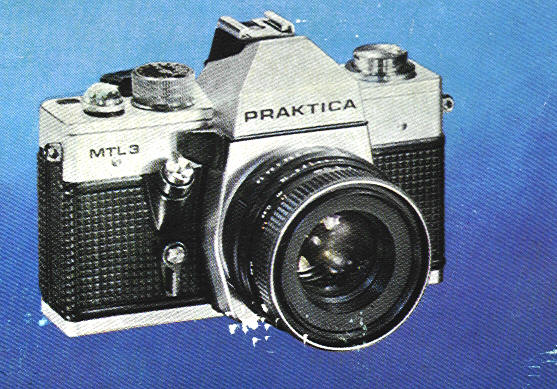
Almost all pictures in Gerard's Radio Corner were shot with the Practika
M3 shown on the right.
directly, but I am a very old fashioned man and still use chemical
photography.
Almost all pictures in Gerard's Radio Corner were shot with the Practika
M3 shown on the right.
There is still an advantage of chemical photography, at least as compared to the results of some cameras: the picture quality is better. Of course I realise that this will not last for long anymore. There is also a big disadvantage: the delay caused by having to shoot an entire roll before the film is developed and printed. With 12 or 24 shots on a roll, and given the rate in which I obtain radios, it takes up to two months sometimes before a new acquisition can be displayed on the web. This is a pity, because I am always very eager to show my latest radios especially if I need some help in the restauration.
I don't find the cost of chemical photography a problem. Did you ever realise the cost of ink cartridges for your printer? Speaking about printers, mine is an HP office Jet which has scanning capabilities as well, and it is the final stage in obtaining JPEG digital images of my radios.
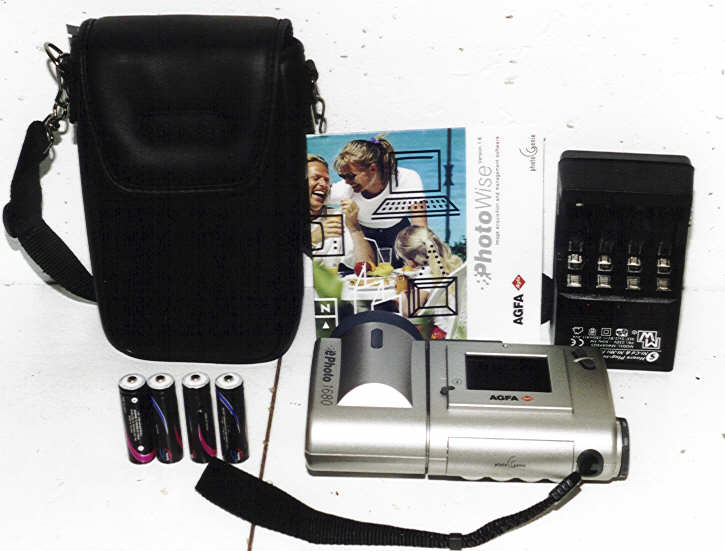 The main reason to buy it was
that I would be able to produce the pictures faster.
But now that I have it, I find the pictures are of better quality also.
Especially the colors are brighter, but also the sharpness is excellent.
It is also easy to control the exact size of the pictures (in pixels).
Meanwhile, many of the older pictures have been replaced
by pictures from the Agfa.
In December, 2003, the Agfa was replaced by a Canon A40,
and in January, 2005, this was succeeded by a Canon A60.
The main reason to buy it was
that I would be able to produce the pictures faster.
But now that I have it, I find the pictures are of better quality also.
Especially the colors are brighter, but also the sharpness is excellent.
It is also easy to control the exact size of the pictures (in pixels).
Meanwhile, many of the older pictures have been replaced
by pictures from the Agfa.
In December, 2003, the Agfa was replaced by a Canon A40,
and in January, 2005, this was succeeded by a Canon A60.
In the first years of adding photos I aimed at a resolution of 640x480 pixels, but in 2005 I switched to 1024x768 because bandwidth is less of a problem nowadays. Also in 2005 I started to add a Sounds archive to GRC, with recordings of the actual playing sets being made with the Canon camera.
That is not the way to go in the twenty-first century. What we demand now is a single place where information is maintained, and can be used in various ways. Now I have my administration in an Excel workmap, and the same workmap also contains sheets and programs to generate the radio descriptions, and aggregated information like the For Sale list, Wanted Parts list, Sounds collection, etc. SiteBuilder has its limitations, but for generating many pages of similar structure with a common layout it is excellent (as you can see from the radio descriptions on my site). The same principle is used in Gerards FotoAlbum.