
451
Item nr.
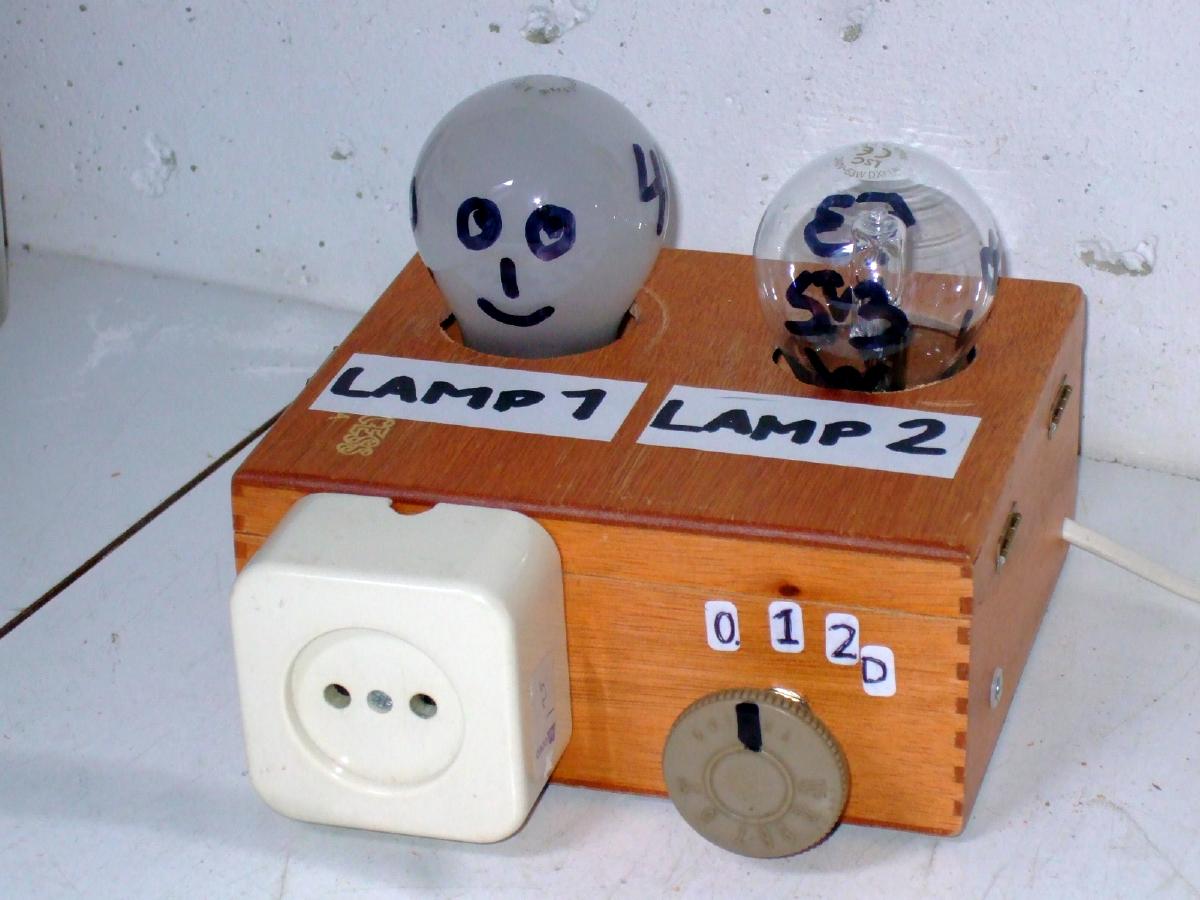
| Production | The Netherlands, 2017. |
|---|---|
| Cabinet | Wood (tea box). Size 16x7x14cm (box). Weight 360gr (inc. two bulbs). |
| Power | AC/DC 230V. |
| Documents | schema. |
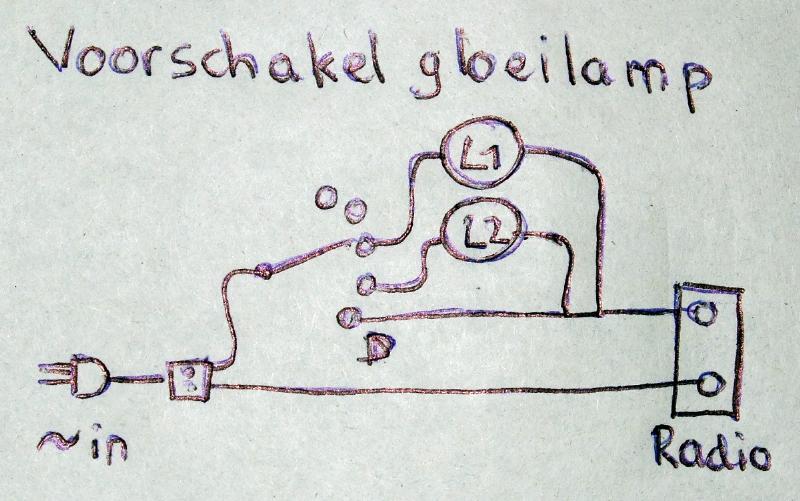 there is a danger of a defect causing high current and damage to the radio. To avoid this, light bulbs can be the perfect current limiter. This unit places a bulb in the AC line for that purpose.
 When starting a certain model, put bulbs in the unit of (1) comparable power as the radio and (2) double that power. Start in position 1, the radio only gets a little power then, and you can see if there is no smoke anywhere. When all seems OK, switch the higher bulb, or even D (Direct connection to AC power).
| Obtained | 2/2017 from Scrap parts. |
|---|---|
| Condition | 8. |
| Value (est.) | 2,2€. |
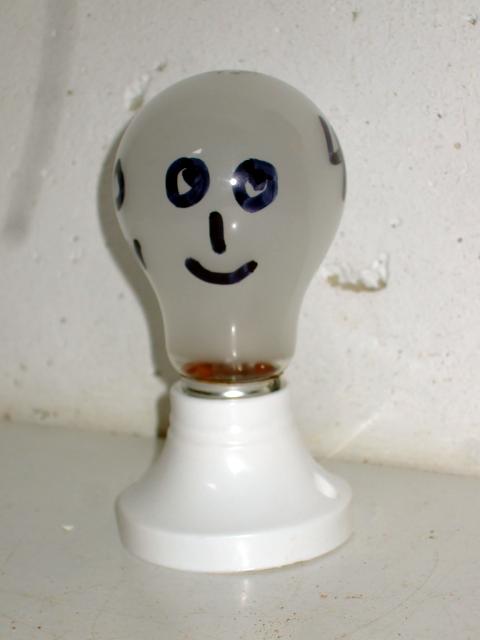 I have repaired and started up about 160 tube radio without this device, but with the sets becoming older, the risks increase. I considered building the unit on a board, but found my sockets (left) unsafe wrt. touching; see metal part under glass envelope. So I went to the recycle shop for a little wood box and a wall socket.
 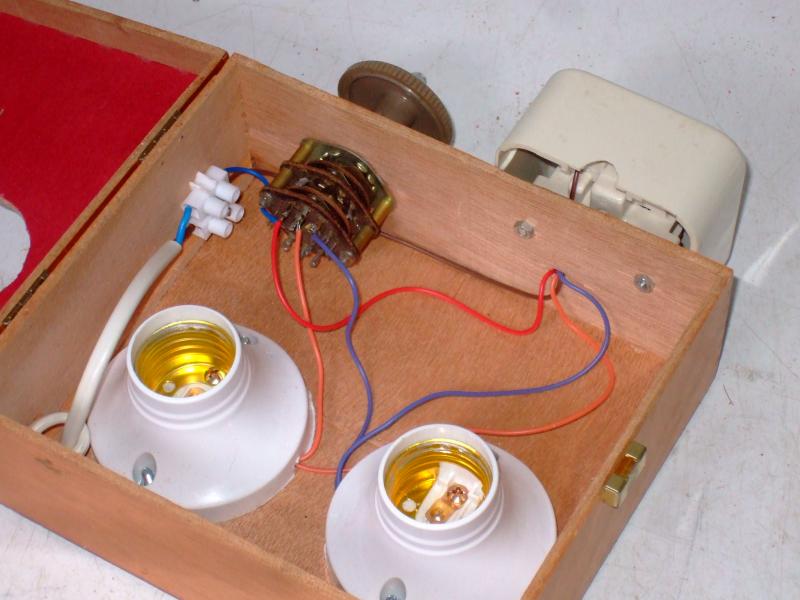 I restrained my self a little bit and restricted myself to a unit with two light bulbs. Together with Direct and Off (0), this requires four positions on the swith, but my switch had five positions. Assembly was not at all difficult. The mains lead has blue and brown wires, of which the brown goes directly to the socket. The blue goes to the switch. Lamp 1 has purple leads to the switch and the wall socket. Lamp 2 has orange leads.
Never use this without bulbs! It would be touch-unsafe then. I have various bulbs, including a 7W one for testing transistor radios.
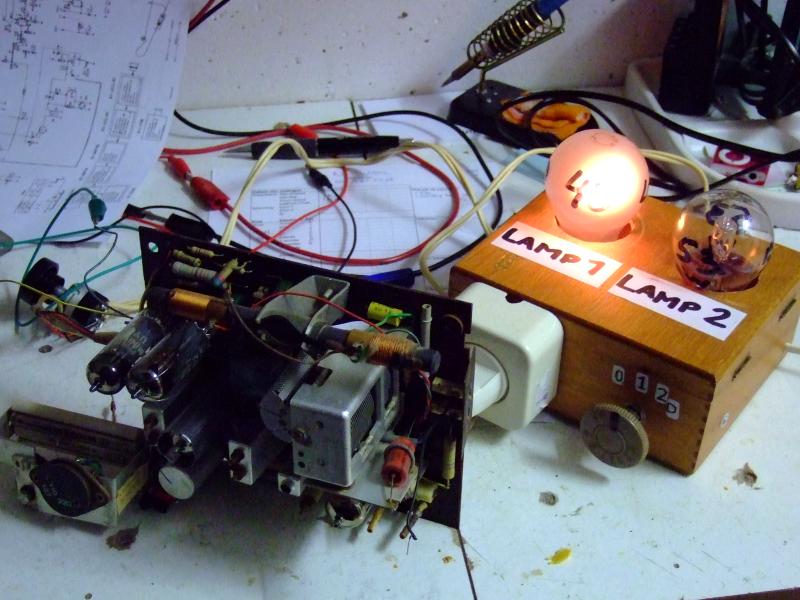 Two days after assembly I undertook to start up a Philips B2X40U, especially left unrepaired for this occasion. It started up perfectly and softly, and already plays a bit with a 40W bulb in series.