
624
Item nr.
| Production | The Netherlands, 2026. |
|---|---|
| Bands | IF (450-457kHz). |
| Semi- conductors | NE555 (osc), 7805 (stab), LED. |
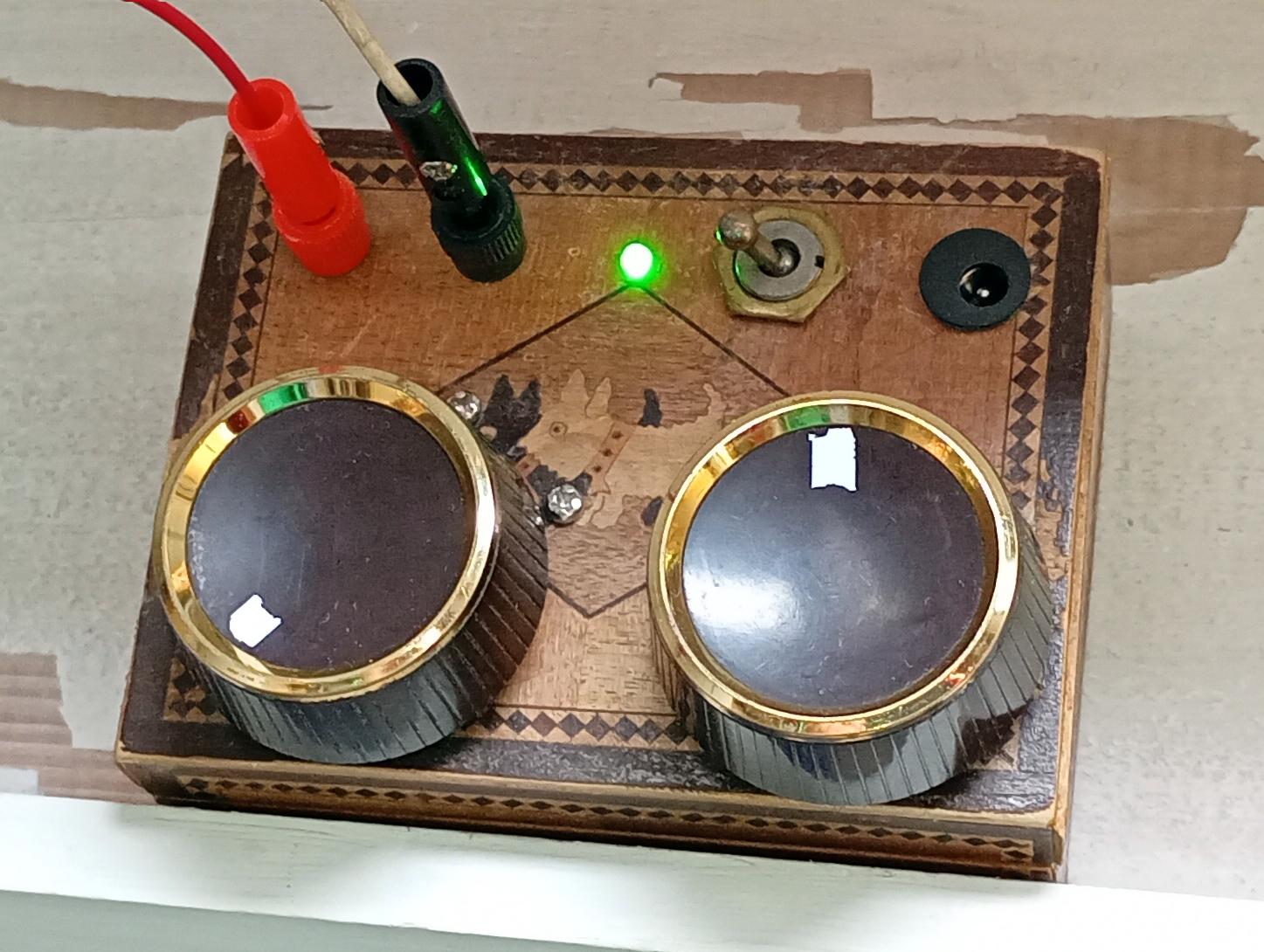
| Cabinet | Wood. Size 12x9x5cm. Weight 275gr (inc batt). |
| Power | 9V (Batt or DC), 8mA. |
| Documents | Schema, Use diagram. |
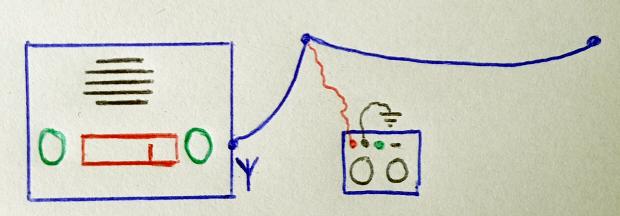 Clip the output to your aerial and, when you hear the mumbling sounds of an SSB station, switch on the Toekan and try to make the sounds understandible with the clarifier control. Coupling with the radio can be done in several ways. Connecting it to the antenna keeps the unit purely "external", but forces the signal through the HF circuits and may cause interference. You get better results connecting the output of the Tucan to a shield around the mixing tube.
My shack 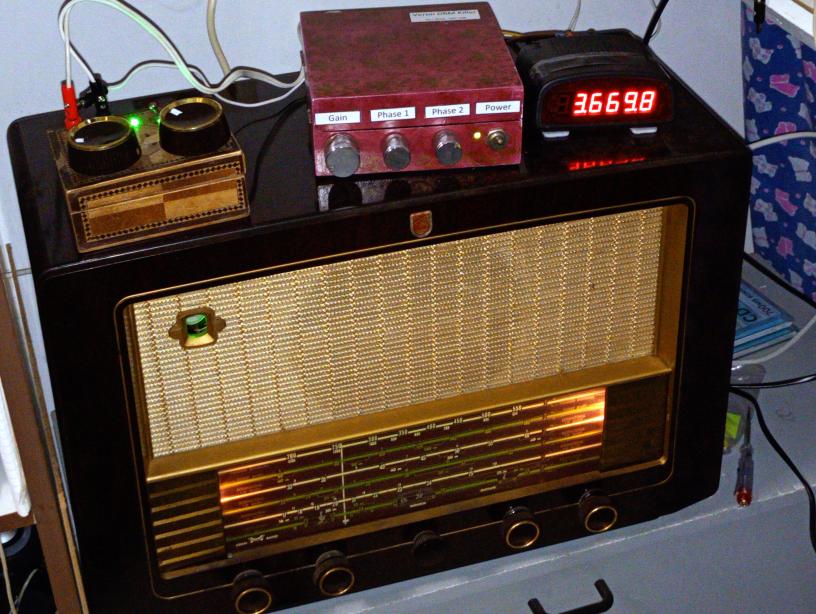 looks very professional with the Toekan stacked on the Philips BX645U, together with my external Cymometer and the Veron QRM killer to overhear an 80m ham and a 40m ham.
| Obtained | 3/2026 from Scrap parts. |
|---|---|
| Condition | 8. |
| Value (est.) | 2,2€. |
| Sound sample | PLAY SOUND Weather forecast from Volmet at 5450kHz USB. |
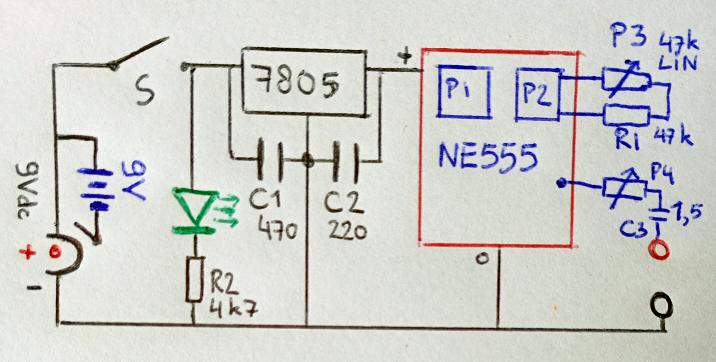 provided with an extra potmeter control that varies the frequency between 150 and 153kHz; the third harmonic will range from 450 to 459kHz, the Intermediate Frequency of classic tube radios.
 Power is from a 9V battery or external DC supply, the current draw is under 8mA.  Commonly available NE555 units have two variable resistors controlling the freqency. I don't know why, but for this project the double control comes very handy. Both controls are 10kOhm and they are in series. I bridged P2 by a 47k resistor plus a 47k linear potmeter, allowing to vry the overall value of P2 by some amount that depends on the value of P2. Because the unit is an "audio" type and goes only as high as 200kHz, we'll use the third harmonic as our BFO. Arrange P1 and P2 such, that P3 can reach frequencies from 150 to 153kHz. If the range is too large, you must reduce P2 (higher frequency) and increase P1. P4 controls the output level and is 47kLog with switch.
Obviously, the Toekan might profit from an extra filtering at Intermediate Frequency. I experimented with an IF filter (white TOKO) from a scrap radio, placed between the NE555 and the attenuator. But alas, I got no better results (rather worse) than without, so the filter was taken out of schema again.