
 because a lot of stations close down or switch
to other technologies like Internet, FM, or DAB+.
On Shortwave, there are still a great variety of SSB stations
that can be received, but older AM sets cannot reproduce
the sound audibly.
All you hear on an AM set is some mumbling;
it can be a nice sport to guess the language,
but understanding the speech is impossible for most.
because a lot of stations close down or switch
to other technologies like Internet, FM, or DAB+.
On Shortwave, there are still a great variety of SSB stations
that can be received, but older AM sets cannot reproduce
the sound audibly.
All you hear on an AM set is some mumbling;
it can be a nice sport to guess the language,
but understanding the speech is impossible for most.
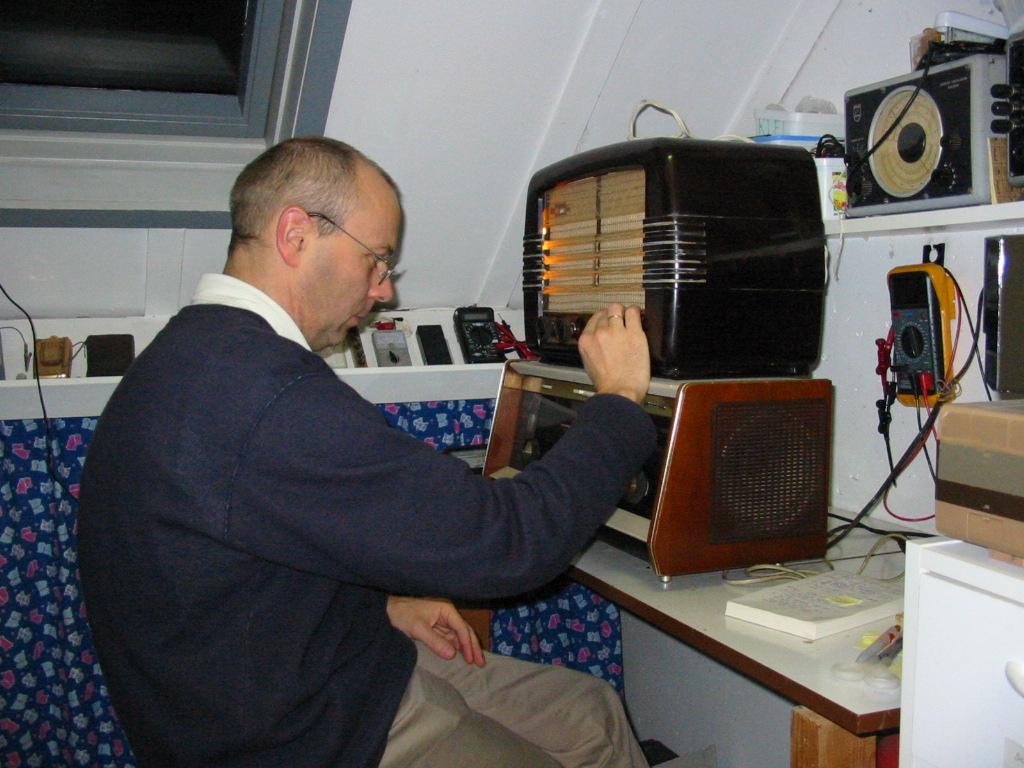
The Two Receiver method, illustrated by the photo on the right,
allows you to overhear
SSB transmissions
on an AM receiver, using a second set as a helper.
Thus you get more fun out of your vintage AM sets,
especially for sets with Tropical Band (1.6 to 5.8MHz)
because few AM stations work in this band.
A standard AM transmission is composed of a "carrier", which is just something like a high frequent tone, combined with the sound information. In an SSB signal, the carrier is left away, and the method replaces it with a high frequency tone produced by the Secondary. Indeed, each radio contains a Local Oscillator, producing a high frequency tone, usually about 450kHz higher than the frequency that is tuned. Normally, this tone is unnoticed, but it isn't difficult to detect it with another set, or to employ it as the missing carrier for an SSB station.
| SSB Sounds |
|---|
| Hello Alfred |
| SSB Mumble |
| Coarse tuning |
| Fine Tuning |
| Volmet (with Toekan) |
Next, tune the secondary very precisely to make the station sound understandible. For a Lower Side Band station (as in the 80m, 40m, and 160m Ham bands), tune the Secondary a little higher than the point of maximum interference. If the sound is pitched too high, tune down the Secondary and if it sounds too high, tune up. For Upper Side Band stations (VolMet, ships, military, 20m and 60m Ham bands), it works the other way around.
 like this Tecsun PL-680,
Trio 102,
or Philips D2999,
have an extra built in oscillator to provide the missing carrier.
Also, the bandwidth of these radios is narrower,
and they allow to control the strength of the SSB signal.
Ease and quality of reception are often better
then can be achieved with the Two Receiver method.
like this Tecsun PL-680,
Trio 102,
or Philips D2999,
have an extra built in oscillator to provide the missing carrier.
Also, the bandwidth of these radios is narrower,
and they allow to control the strength of the SSB signal.
Ease and quality of reception are often better
then can be achieved with the Two Receiver method.
It is possible to modify a vintage tube radio by building a BFO that works at the Intermediate Frequency; I did this in an old scrap set and obtained very satisfying results.
 The famous Grundig Satellit 2100
could be extended with external BFO,
called the SSB Zusatz.
This unit also works at the Intermediate Frequency.
The famous Grundig Satellit 2100
could be extended with external BFO,
called the SSB Zusatz.
This unit also works at the Intermediate Frequency.
Another external BFO is the Toekan, a small set top box that produces an IF signal, but inserts it through the antenna circuits. Succes requires a stable hand and some luck. The Kaketoe is basically a secondary receiver with everything stripped off but the oscillator; it operates exactly as described above.
 with stations between 7050 and 7200 kHz,
your Secondary must tune 6600 to 6800kHz.
All Shortwave radios will suit as Primary and Secondary.
You'll hear German, English, Italian, Dutch, Russian, and a lot more.
with stations between 7050 and 7200 kHz,
your Secondary must tune 6600 to 6800kHz.
All Shortwave radios will suit as Primary and Secondary.
You'll hear German, English, Italian, Dutch, Russian, and a lot more.
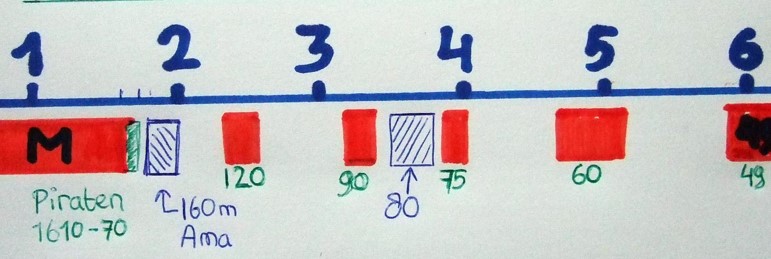
For the 80m Ham band, your Primary must tune 3600 to 3800kHz, and the Secondary must go down to 3150, so it should include the 90m band. There is also a 160m Ham band, with little traffic, so it's quite a sport to receive some Hams there. For the Secondary you must use the upper Medium Wave.
There is a 60m Ham band, around 5300 to 5400kHz, but it is rarely used. The 20m band, from 14100 to 14350kHz, is more challenging to receive, because it is difficult to tune the Secondary sufficently precise at these high frequencies.
Volmet stations provide weather information for airports.
They are found at many frequencies,
including 3413, 5450, 5505, and 8957kHz.